SPOTLIGHT ON COMMUNITY: BASU and Pam Basu
Updated: May 5

BASU and Pam met in 1989 in Pembroke and later married and have eight children. They chose to live in Pembroke for similar reasons. Pam felt it was the best place to raise kids and liked the environment, the freedom, and farming. BASU wanted to get out of the city of Chicago, away from drugs and violence, and return to nature and living on the land. Their shared purpose brought their separate journeys together.
Pam Basu
Pam’s family, the Wards, moved to Pembroke from Chicago in 1959 when the Cabrini Green apartments were being built on the South Side of Chicago. She was in 3rd grade. As one of the first students at Lorenzo R. Smith School, she was a student of Ida L. Busch. The Pembroke School District later dedicated one of their grade schools to this teacher, naming it Ida L. Busch School.
Pam recalls attending St. Anne Community High School when Martin Luther King, Jr. was assassinated and riots broke out at the high school. Superintendent Lorenzo R. Smith had to send buses to get the students because the high school’s administrators would not take the Pembroke students home.
She went on to further her education, obtaining three associate degrees from Kankakee Community College in Computer Programming, Accounting, and Marketing, while at the same time raising her children as a single mother.
She became involved with Rehoboth Mennonite Church, where Mark Lehman was the pastor. There, she participated in the church’s community outreach—Summer Day Camp, Vacation Bible School, and bee and blueberry farming. Pastor Lehman started a Habitat for Humanity chapter in Pembroke, and Pam was one of the first families to receive a Habitat for Humanity home located in Garden City, one of the early subdivisions in northeast Pembroke.
BASU, originally from Pittsburgh, Pennsylvania, lived in Chicago and came to Pembroke in the 1980s. He initially came for horseback riding, then began working for Moscickis Real Estate Agency while also working for Illinois Bell. During this time, he traveled back and forth between Chicago and Pembroke. As soon as he was able to purchase his own property in Pembroke, he did.
With Pembroke being a predominantly Black community, BASU marketed land to that population. He was the agent who sold land to Sharadi and Johari Kweli, CDC’s Executive Director followed by Marc Haygood, a CDC board member; and Jifunza Wright and Fred Carter, owners of Black Oaks Center. He eventually stopped working for Frank Moscickis and opened his own real estate agency, BASU Realty.
BASU
BASU introduces himself simply as BASU. The response he often gets is, “Is that it? What’s your last name?” BASU explains how he embarked on a journey to Africa to find his people and learn where he came from. When he met the Basuto tribe in Southern Africa, he noticed the resemblance. He took on their name as BASU and left it as that.
A serious car accident led BASU to reconnect with Mother Earth in search of her healing energy to rejuvenate his mangled body. He became a master yogi, applying yogic techniques to repair his bones in his legs and spine. After much suffering and years of practice, his body showed its ability to recover. He eventually had all the medical steel rods and pins removed to allow his body to express its full healing capacity.
He shared his appreciation for life and his knowledge of the yogic arts at community events and festivals, offering classes and demonstrations to encourage others to allow the energy of Mother Earth to rejuvenate their bodies for healing, vitality, and longevity.
Basu Natural Farms
BASU and Pam’s paths intertwined as next-door neighbors in Garden City. They began farming together in the fields behind their homes. BASU did not know much about farming at the time but wanted to learn in his desire to reconnect with the land. Pam, who grew up farming, encouraged him and shared her knowledge. He learned by doing. This shared desire led them to purchase a 36.5-acre property on the north end of Pembroke Township, where they built their family farm business, Basu Natural Farms.

They also shared a desire to serve in local government. BASU served for 16 years as the Pembroke Township Tax Assessor, believing his experience as a real estate agent prepared him well for the role.
Pam served as Village of Hopkins Park payroll clerk in the 1980's and later as Treasurer. She then served as Pembroke Township Clerk and later as Tax Assessor, having been trained under BASU as his apprentice.
In the late 1990s, BASU and Pam helped form an activist group called Pembroke Advocates for Truth (P.A.T.) to push for government transparency surrounding a proposed prison development slated for the Pembroke community. The prison was to be located next door to the BASUs’ 36.5-acre natural farm. Pam’s involvement threatened her job with the Village. Through P.A.T.’s efforts, and in the face of losing her job, both Illinois and Village governments were exposed for failing to disclose conflicts of interest among certain politicians involved in the deal.
Shifting their focus from politics to farming in 1999, BASU and Pam started the Pembroke Farmers Coop to bring farmers together to grow fruits and vegetables. About 12 farming families participated. This later expanded into the Pembroke Farm and Family (PFF) organization to include livestock, and it continues to operate today.
Their family farm has since been passed on to their son, Shango. He began as a child by establishing a bee farm to help pollinate crops. Today, he has expanded the farm to include livestock—goats, rabbits, turkeys, chickens, eggs—and more. He has also expanded the greenhouse to sell transplants and developed a nursery with over 100 varieties of daylilies.
“When he was a kid,” Pam recalls, “he told us he was never going to be a farmer. He wanted to move to Florida and lay on the beach.”
Their 36.5 acres provided the capacity to pursue many initiatives sparked by community vision. They now host three annual festivals on the farm during the summer, each rooted in community leadership.
The Herb Festival takes place Memorial Day weekend (Saturday and Sunday in May). After years of attending a similar festival in Momence, the retiring organizer encouraged them to start one. They did—and it is now in its 25th year.

The Juneteenth Celebration is held on the third weekend (Saturday and Sunday) of June. After community members introduced the idea from Texas celebrations and initially organized it at Pembroke Park, they passed it on to BASU and Pam. It is now also in its 25th year.

The Marcus Garvey Festival takes place on the third weekend (Saturday and Sunday) of August. Sharadi and Johari first introduced and hosted it in 1998. After years of exponential growth, the BASUs volunteered their property to make it more accessible to the public. With farm demonstrations already taking place, it became a natural extension of Garvey’s principles and contributions. The festival, now in its 28th year, also serves to counter misconceptions about Garvey’s message.

When asked how they have sustained these events for so long, they point to the involvement of family and community—children, grandchildren, cousins, and neighbors—who continue to carry the work forward.
The BASUs also established the BASU Museum and Cultural Center. Pam, a dedicated doll collector, gathered dolls from antique shows, yard sales, and auctions, representing Black and Native American cultures. After realizing she had accumulated over 4,000 dolls, she created a space on their property to house the collection, which became the foundation of the museum.
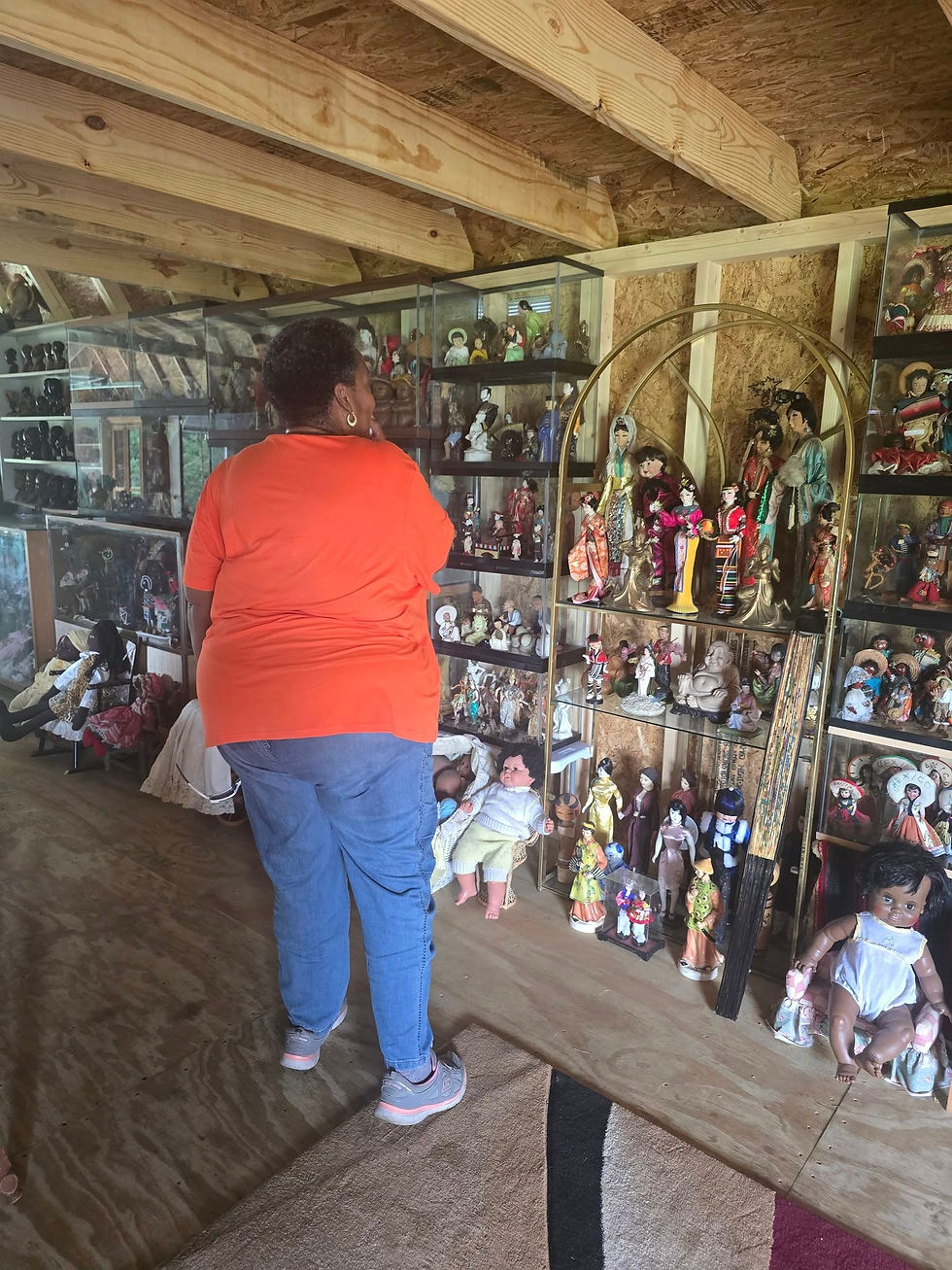


They also operate a store offering tinctures made from herbs, flowers, and plants from their nursery, as well as African garments, statues, and more. Pam later became certified as a Master Herbalist, Master Preserver, and Master Gardener through the University of Illinois. She plans to expand further by adding a library and teaching space on the property.
Their daughters, Vena and Nefatara, along with several grandchildren, now help manage the museum, store, and community events. Nefatara specializes in restoring museum artifacts, and her children have developed a strong interest in history, growing up watching films like Eyes on the Prize. Vena manages public relations, marketing, and media promotion. Pam believes their children embraced these roles because they were raised in a rich cultural environment with a strong connection to the land.
When asked why they have continued this work, Pam shared,
“We wanted the next generation to know who we are and where we came from. My people are from Jamaica. My lineage comes through the Arawak, Apache, and Cherokee Nations. Ultimately, all are from Africa—we just got here at different times, on different ships.”


The BASUs live off-grid, with their home powered primarily by a segregated solar system and generators, using propane for heat. Living far from the road, they found this approach to be more cost-effective and aligned with their way of life.
Visit the BASU Natural Farms Facebook page:
Author: Louise Campbell-Anthony
Edited: Johari Cole-Kweli


Comments